


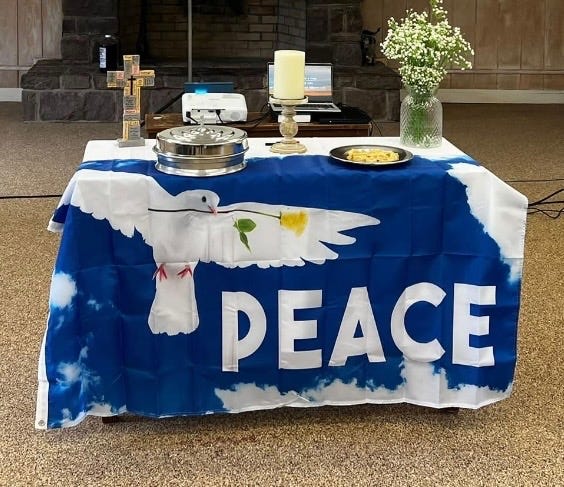
This weekend was our beautiful Church retreat in New Hope PA.
And the theme we have been given for this weekend is deceptively simple: Choosing Peace.
Not finding peace.
Not waiting for peace.
Not hoping that someday the world around us will finally become peaceful. Choosing peace.
There is something intentional about those words.
Because peace is not always the natural choice.
When someone hurts us, peace may not be our first instinct.
When we feel misunderstood, peace may not be our first instinct.
When somebody disagrees with us — especially about something we care deeply about — peace may not be our first instinct.
Sometimes we want to defend ourselves.
Sometimes we want to prove that we’re right.
Sometimes we want to retreat.
Sometimes we want to stop listening.
And yet Jesus continually calls us toward another way.
He said:
“Blessed are the peacemakers, for they will be called children of God.” I find it interesting that Jesus didn’t say, “Blessed are the peace-lovers.” He said peacemakers.
Because making peace requires something from us.
It means peace isn’t simply the absence of conflict. It is something we participate in creating.
And sometimes choosing peace is hard.
For me, that word choosing has become especially meaningful.
There have been times in my own life when peace seemed very far away. As many of you know, I’m gay.
And for many years, I tried to reconcile who I knew myself to be with what I believed God expected me to be.
There was a great deal of fear in that struggle.
Fear of rejection.
Fear of disappointing people I loved.
And perhaps most painfully, fear that somehow being fully myself might separate me from God.
I spent a lot of time believing that peace would come when I finally figured everything out. When I had all the theological answers.
When everybody understood me.
When nobody disagreed with me anymore.
But that isn’t how peace came.
Peace began when I finally understood something much simpler:
God had never stopped loving me.
I didn’t have to earn my place at Christ’s table.
I didn’t have to become somebody else before God could love me.
And I didn’t have to wait until everyone else understood my journey before I could begin living in the light of that love.
That realization changed something in me.
Because once we truly begin to understand that we are loved by God, we can begin extending that same grace to other people.
Even people who don’t understand us.
Even people who disagree with us.
Even people who may still have some growing to do.
And certainly people with whom we still have some growing to do.
That doesn’t mean pretending differences don’t exist.
Peace is not pretending.
Peace is not silence in the face of injustice.
Peace is not asking someone who has been wounded to simply tolerate being wounded again.
Jesus’ peace was never passive.
Jesus challenged systems.
He confronted hypocrisy.
He crossed boundaries.
He ate with people others rejected.
He touched people others considered untouchable.
And somehow, in the middle of all of that disruption, he could still say: “Peace I leave with you; my peace I give to you.”
That is a very different kind of peace.
It is not the peace that comes when everything around us is calm.
It is the peace that comes when we know who we are, whose we are, and how we have chosen to live.
And I think that connects beautifully with who we are as Community of Christ.
We talk about the Worth of All Persons.
We talk about Unity in Diversity.
We talk about Continuing Revelation.
And, of course, one of our Enduring Principles is Pursuit of Peace — Shalom. Those aren’t just nice words to put on a wall.
They describe choices.
To affirm someone’s worth is a choice.
To remain in community with people who see things differently is a choice. To remain open to new understanding is a choice.
To pursue peace is a choice.
And I think that is especially important in a church.
Because churches are made up of human beings.
We bring our histories with us.
Our personalities.
Our experiences.
Our wounds.
Our traditions.
Our hopes for the future.
And sometimes we will disagree.
That’s okay.
Unity does not require uniformity.
We don’t have to think exactly alike in order to sit at the same table.
In fact, perhaps one of the most powerful witnesses the church can offer the world right now is not that we have figured out how to eliminate every disagreement.
Perhaps our witness is that we have learned how to love one another through them. To listen before answering.
To remain curious about another person’s story.
To assume good intent when we can.
To apologize when we cause harm.
To forgive when forgiveness becomes possible.
To speak truth without surrendering compassion.
And sometimes simply to say:
“I don’t see this the way you do, but you still matter to me.”
Imagine what could happen if that became one of the defining characteristics of Christian community.
But I would add one more line:
The presence and voice of the person sitting beside you matters too. And the person across the room.
And the person who has been part of the church for fifty years.
And the person who walked through the doors for the first time last month. The person who has certainty.
And the person who has questions.
The person who agrees with us.
And the person who doesn’t.
Because somehow, God keeps inviting all of us to the same table.
We can choose what kind of people we want to be with one another.
We can choose to listen.
We can choose kindness.
We can choose curiosity over judgment.
We can choose relationship over winning.
We can choose to recognize the worth of the person whose voice is different from our own. And again and again, when the opportunity presents itself,
we can choose peace.
Because peace isn’t something we choose once.
We choose it in moments.
We choose it in conversations.
We choose it in relationships.
We choose it when it is easy.
And perhaps most importantly, we choose it when it is not.
So my prayer is that the peace of Christ will not simply be something we talk about.
May it become something we practice.
May we see Christ in one another.
May we listen deeply.
May we speak graciously.
May we remember the worth of every person.
And when we encounter those moments when another path would be easier… may we have the courage to choose peace.
Amen
.
What you wrote on peace was beautiful, Carl. So many things to consider in ourselves and how we choose to carry our peace as we relate to others, whether or not others believe in us or understand us. God knows, He sees us, He provides, He cares, He guides us, and ultimately His love carries us.