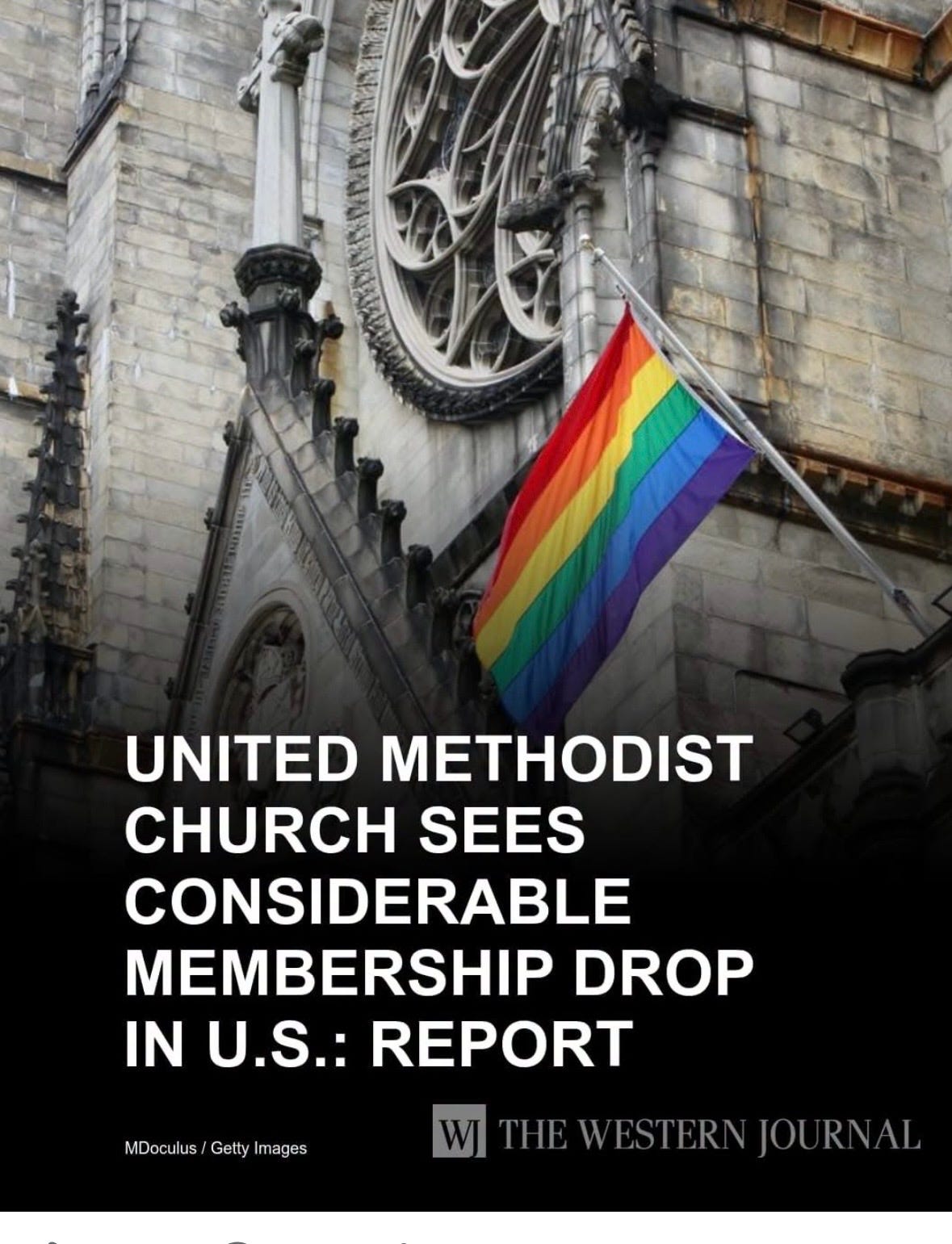

As I continue Episode 11 (in an 8 part series) - and as I launch Part 2, I want to remind you of this important topic: "The People Jesus Welcomed." As I'm writing these I'm bombarded with the news in this picture.
But here is something to think about:
I keep seeing these articles about declining membership in the United Methodist Church (and others) often presented as though declining numbers are evidence that a church has abandoned biblical truth.
But since when did Jesus measure faithfulness by membership statistics?
Jesus said, “For where two or three are gathered in my name, I am there among them” (Matthew 18:20).
Jesus never commanded his disciples to build the largest denomination, fill the most pews, or maintain the highest membership rolls. He commanded them to love one another (John 13:34–35), care for the marginalized (Matthew 25:35–40), and love their neighbors as themselves (Mark 12:31).
Perhaps what we’re witnessing isn’t simply the decline of a church. Perhaps we’re witnessing a necessary transformation.
When Community of Christ opened the priesthood to women in 1984, many members left. It was painful and divisive. But today, women serve throughout the church, including in its highest leadership. What some considered a betrayal of tradition became an opportunity for greater equality and inclusion.
The United Methodist Church is experiencing its own difficult transformation as it moves toward greater LGBTQ inclusion. Yes, many conservative congregations have departed. But does their departure automatically mean the church has lost its way? Or could it mean the church is becoming more faithful to the radical inclusivity demonstrated by Jesus?
I would much rather worship in a congregation of 25 people who genuinely welcome everyone than in a congregation of 2,500 where people are made to feel ashamed or unwelcome because of who they are.
And let’s remember something else: Christianity is declining across many denominations, including those that oppose LGBTQ inclusion. It is intellectually dishonest to attribute every membership decline to a church becoming more welcoming.
Jesus spoke of knowing a tree by its fruits (Matthew 7:16–20). Perhaps we should measure churches less by how many people occupy their pews and more by how much love, compassion, justice, healing, and peace they bring into the world.
A smaller church that reflects the love of Christ is not necessarily a dying church. It may be a church finally discovering what it means to follow him.
The Gospel was never about winning a popularity contest. It was about transforming lives through love.
And that is a church worth belonging to.